Selecting the right stainless steel wedge wire filter nozzle is essential for achieving stable filtration performance, long service life, and efficient backwashing. Incomplete or unclear specifications often lead to mismatched products, reduced efficiency, and unnecessary costs.
Why Accurate Specification Matters
A well-defined filter nozzle specification helps manufacturers deliver exactly what your system requires. It reduces communication errors, shortens lead time, and ensures compatibility with your filtration media, operating conditions, and installation setup.
Poorly specified nozzles can result in:
Media leakage due to incorrect slot size
Premature corrosion from unsuitable material
Flow imbalance caused by improper design
Installation issues due to mismatched threads or dimensions
Key Parameters to Define in Your RFQ
To ensure clarity and consistency, include the following technical details when requesting a quote.
1. Material Selection
Material determines corrosion resistance, durability, and suitability for different environments.
316L Stainless Steel: Preferred for most water treatment and chemical applications due to superior corrosion resistance
304 Stainless Steel: Suitable for less aggressive environments
904L Stainless Steel: Ideal for highly corrosive conditions (e.g., seawater or acidic systems)
Recommendation: Default to 316L unless specific chemical conditions require otherwise.
2. Slot Size (Critical for Filtration Performance)
Slot size directly affects media retention and filtration efficiency.
Typical range: 0.025 mm to 12.5 mm
General rule: Slot width ≈ 50% of the smallest filter media grain size
Example:
If the smallest media particle is 0.4 mm → recommended slot size ≈ 0.2 mmThis balance prevents media loss while maintaining adequate flow.
3. Thread Type and Size
Thread compatibility ensures easy installation and secure fitting.
Common standards include:
NPT (National Pipe Thread)
BSP (G thread)
Metric threads (e.g., M30)
Tip: Always specify both the thread standard and size (e.g., 3/4" NPT male).
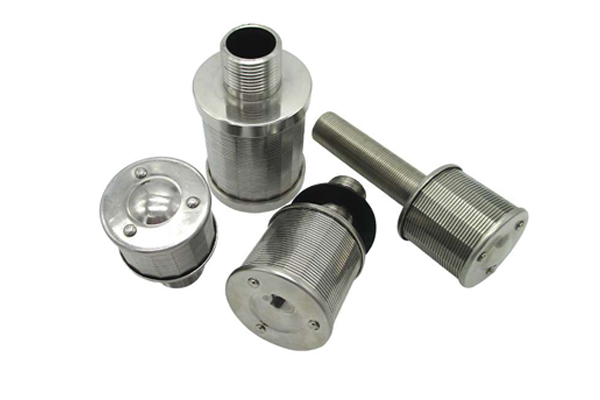
4. Nozzle Configuration
The nozzle design affects flow distribution and backwashing efficiency.
Single-head nozzle: Standard filtration applications
Long-neck (double-head) nozzle: Designed for air-water backwash systems
Choose based on your system’s operational requirements.
5. Dimensions
Accurate dimensions ensure proper installation and system compatibility.
Key measurements include:
Outer diameter (commonly 2")
Total length
Neck length (especially important for long-neck designs)
Even small deviations can affect performance and fit.
6. Flow Rate and Operating Conditions
Provide actual working conditions to ensure the nozzle performs as expected.
Include:
Required flow rate per nozzle
Operating temperature
Pressure conditions
These factors influence structural design and slot configuration.
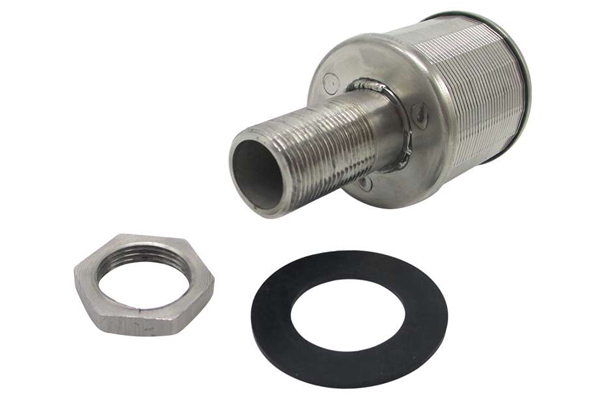
7. Hardware Requirements
Specify whether additional components are needed:
Gaskets (rubber or PTFE)
Washers (steel or stainless steel)
This ensures the product is ready for installation upon delivery.
Manufacturing Considerations That Impact Quality
Beyond specifications, manufacturing quality plays a critical role.
A high-performance wedge wire nozzle should feature:
Continuous slot structure for uniform flow
Strong welding between the wedge wire screen and threaded nipple
This construction improves durability, reduces maintenance, and enhances filtration efficiency.
Specifying a stainless steel wedge wire filter nozzle correctly is not just a technical step—it is a critical factor in ensuring long-term filtration efficiency and system reliability.
A structured RFQ with clear material, slot size, configuration, and operating details allows manufacturers to deliver precisely engineered solutions that meet your performance expectations.
FAQ: Common Questions About Filter Nozzle Specification
1. How do I choose between 316L and 904L stainless steel?
Choose 316L for most water treatment applications. Use 904L only when dealing with highly corrosive media such as seawater or strong acids.
2. What happens if the slot size is too large or too small?
Too large: Filter media may escape, causing system failure
Too small: Increased clogging risk and reduced flow rate
Correct sizing balances retention and flow efficiency.
3. Can I use the same nozzle design for different filter media?
Not always. Different media sizes and densities require different slot sizes and sometimes different nozzle configurations.
4. How important is nozzle length in system performance?
Nozzle length affects flow distribution and backwash efficiency. Long-neck designs are especially important in dual-media or deep-bed systems.
5. Should I include spare parts in my RFQ?
Yes. Including extra gaskets, washers, or a small percentage of spare nozzles helps reduce downtime during maintenance.
6. What information do suppliers often miss in RFQs?
Common omissions include flow rate, operating temperature, and exact thread standard. Providing these details upfront improves accuracy and avoids delays.

 Engineering Principles Behind Vee Wire Scallops for Catalyst Support Systems
 Tower Internal Wedge Wire Pipe Maintenance and Reliability
 Catalyst Bed Support Grid Design for High Efficiency Reactor Flow
 Choosing the Right Vee Wire Scallops for High-Performance Radial Flow Internals
