
A Coal Centrifuge Basket is a screening component used inside a centrifuge for mechanical coal dewatering. It separates water from coal by combining centrifugal force with a precisely controlled screen opening. The basket design affects moisture removal, solids retention, throughput, and wear life.
A Coal Centrifuge Basket is typically a cylindrical or conical screen basket installed inside a coal dewatering centrifuge. Wet coal is forced against the rotating basket, where water passes through the screen openings while the coal solids are retained and moved toward the discharge.
Wedge wire is commonly used to manufacture these baskets. Surface wires are welded to support rods to create continuous slots with controlled openings. This structure provides the screening surface and mechanical strength required for high-speed operation.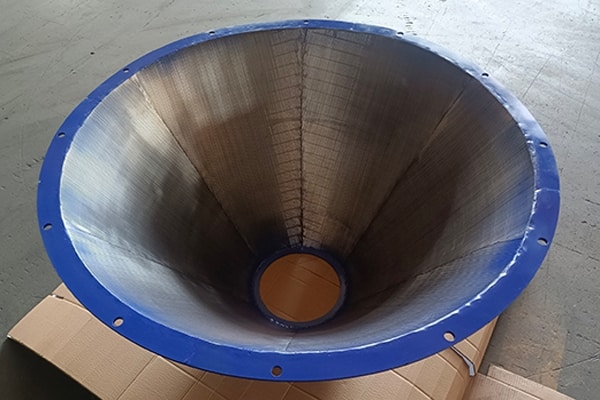
The working principle is based on centrifugal force.
Wet coal enters the rotating basket and is pushed against the screen surface. Water moves through the slots under centrifugal force, while larger coal particles remain inside the basket. The rotation then helps transport the dewatered coal toward the discharge.
The basic process is:
Wet coal → centrifugal force → water passes through slots → coal is retained → dewatered coal is discharged
The slot opening is critical because it must provide enough drainage without allowing excessive fine coal to escape.
Three factors are particularly important.
Slot opening: A smaller slot can improve fine-solid retention but may restrict drainage. A larger slot can increase drainage capacity but may increase fine-particle loss. The correct opening depends on coal particle size and the required separation result.
Open area: Open area determines how much of the basket surface is available for water drainage. A suitable combination of slot size and open area can improve throughput without sacrificing solids recovery.
Material and structure: Coal is abrasive, and the basket operates under continuous centrifugal loads. Stainless steel or other wear-resistant materials may be select ed according to operating conditions. Wire profile, support rods, welding quality, and basket geometry also affect service life.
Wedge wire creates continuous slots between adjacent profile wires. The controlled slot geometry provides a combination of drainage and particle retention, while the welded support structure provides mechanical strength.
The V-shaped slot can also reduce particle blockage compared with some conventional screening structures. These characteristics make wedge wire suitable for demanding dewatering and separation applications.
A published coal dewatering case used a wedge wire centrifuge basket with a 0.40 mm slot opening, 28% open area, and 1200 RPM operating speed. The reported application achieved approximately 8–10% lower residual moisture and 12–15% higher throughput after replacing a perforated basket.
These figures belong to the reported application rather than representing guaranteed results for every coal plant. They demonstrate why basket design should be evaluated as a combination of slot opening, open area, material, and operating conditions rather than by slot size alone.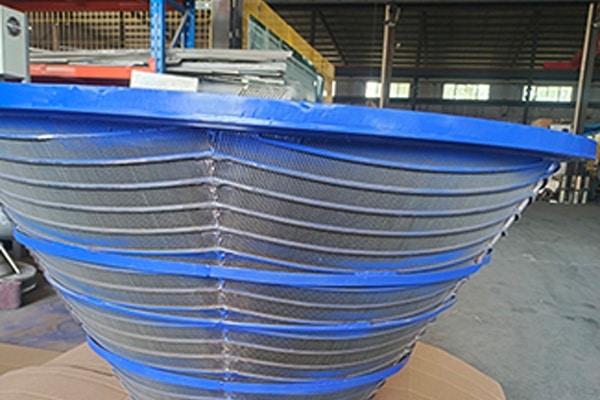
Before specifying a replacement basket, confirm:
The basket should match both the mechanical requirements of the centrifuge and the characteristics of the coal being processed.
For custom dimensions, slot openings, materials, and configurations, Centrifuge Basket can be designed according to specific equipment and operating requirements.
It is used to remove water from coal in a centrifuge while retaining the required coal particles through a controlled screen opening.
There is no universal slot size. Selection depends on coal particle size, feed conditions, required solids retention, and centrifuge design.
Can a Coal Centrifuge Basket be customized?
Yes. Basket dimensions, slot opening, material, wire profile, and structural configuration can be customized to match the centrifuge and application.
 Engineering Principles Behind Vee Wire Scallops for Catalyst Support Systems
 Tower Internal Wedge Wire Pipe Maintenance and Reliability
 Catalyst Bed Support Grid Design for High Efficiency Reactor Flow
 Choosing the Right Vee Wire Scallops for High-Performance Radial Flow Internals
