
In the petrochemical industry, fixed-bed catalytic reactors are widely used in processes such as hydrocracking, hydrotreating, catalytic reforming, and sulfur removal units. Within these systems, the catalyst bed support grid is a critical internal component that directly affects reactor stability and long-term performance.
Although often regarded as a structural element, in real refinery and petrochemical operations, the support grid plays a key role in:
Flow distribution quality
Reactor pressure drop behavior
Catalyst bed stability
Overall unit energy efficiency
Poor design or improper selection can lead to uneven flow, hot spots, accelerated catalyst aging, and unplanned shutdown risks.
In petrochemical units, catalyst beds operate under:
High temperature environments (typically several hundred degrees Celsius depending on process)
Elevated pressure conditions (from medium to high pressure systems)
Continuous long-cycle operation requirements
The support grid must ensure:
Long-term structural stability
Resistance to thermal cycling
Reliable load-bearing of catalyst beds and internals
In refinery reactors, uniform flow distribution is critical for maintaining reaction efficiency.
In well-designed systems:
Flow maldistribution is typically controlled within a low single-digit percentage range
Poor distribution can create channeling and localized overreaction zones
These issues are particularly sensitive in:
Hydrodesulfurization (HDS) units
Hydrodenitrification (HDN) units
Hydrogenation reactors
In petrochemical plants, pressure drop has a direct impact on:
Compressor load
Hydrogen circulation efficiency
Operating cost of the unit
The catalyst bed support grid is designed to contribute only a small portion of total reactor pressure drop, while the majority comes from the catalyst bed itself.
The design objective is always:
stable flow + low unnecessary hydraulic resistance
In refinery and petrochemical reactors, catalyst bed support grids are typically designed as:
Wedge wire support grids (high open area, anti-clogging)
Perforated plate systems (cost-effective, widely used)
Beam-supported bar grids (high mechanical strength)
Hybrid distributor-support structures (for large diameter reactors)
Among these, wedge wire systems are increasingly used in high-efficiency and high-availability units due to improved hydraulic behavior.
Open area selection is a key engineering trade-off:
| Open Area Range | Petrochemical Performance Impact | Typical Application |
|---|---|---|
| ~25–35% | High structural safety, higher resistance | Heavy-duty reactors |
| ~35–50% | Balanced hydraulic + strength performance | Most refinery units |
| ~50–60%+ | Lower pressure drop, moderate strength | High-throughput gas-phase systems |
In refinery design practice, balance is preferred over extreme optimization.
Petrochemical reactors often involve:
Hydrogen-rich environments
Sulfur-containing compounds
High temperature corrosion risks
Therefore common materials include:
Austenitic stainless steels for general service
Duplex stainless steels for higher mechanical strength
Nickel-based alloys for severe corrosion or high-temperature units
Material selection must consider:
Hydrogen embrittlement resistance
Thermal fatigue behavior
Long-term creep performance
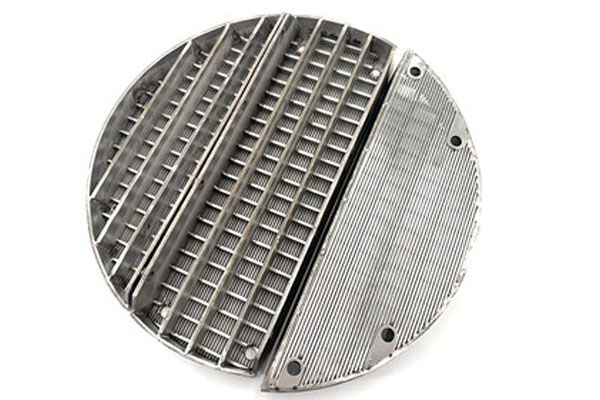
In refinery operations, stable flow distribution is essential to avoid:
Hot spot formation
Uneven catalyst deactivation
Reduced selectivity in reaction pathways
Optimized support grids help maintain more uniform cross-sectional flow, improving overall reactor utilization.
In petrochemical reactors:
Gas-phase velocity is typically moderate and controlled
Liquid-phase systems operate at lower velocities to protect catalyst integrity
Excess local velocity may cause:
Catalyst attrition
Bed disturbance
Increased fines generation
Both simulation and field experience show that poor internal design can lead to:
Flow bypass zones near reactor walls
High-velocity jets at low-resistance regions
Uneven pressure gradient distribution across catalyst bed
Proper design integration significantly reduces these effects.
Pressure drop management is critical in refinery economics.
Key observations:
Pressure drop increases significantly with velocity increase
Higher open area reduces hydraulic resistance
Catalyst bed contributes most of total ΔP, not the support grid
Therefore, the support grid must be optimized to:
Avoid unnecessary resistance
Maintain stable long-term operation
Reduce energy consumption of compressors and circulation systems
Large diameter reactors are especially sensitive to uneven distribution, which may lead to:
Reduced conversion efficiency
Local catalyst overloading
Uneven aging across bed layers
Long-term refinery operation may cause:
Thermal expansion stress
Creep deformation in high-temperature zones
Gradual misalignment of internal structures
High local velocity zones can:
Break catalyst particles
Increase pressure drop over time
Reduce cycle length of the unit
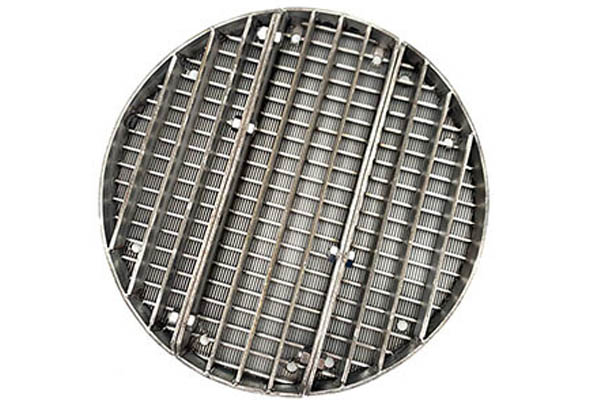
Modern refinery design typically focuses on:
Balanced open area selection for hydraulic/mechanical trade-off
Uniform flow distribution across full reactor diameter
Reinforced structural zones for high load areas
Integration with inlet distributor systems
CFD-assisted design validation before fabrication
The goal is to improve:
unit reliability, catalyst life, and operational efficiency
Because it directly affects flow distribution, pressure drop, and catalyst utilization, all of which determine reactor efficiency and product quality in petrochemical processes.
Common issues include flow channeling, hot spot formation, uneven catalyst aging, increased pressure drop over time, and reduced unit operating efficiency.
In hydroprocessing units (such as HDS/HDN), uneven flow can significantly reduce sulfur and nitrogen removal efficiency and shorten catalyst cycle life.
The key balance is between:
Mechanical strength for long-term load
Hydraulic performance for low pressure drop
Flow uniformity for catalyst efficiency
Because larger diameter reactors are more prone to maldistribution, which can lead to uneven catalyst utilization and significant efficiency loss across the bed.
In petrochemical reactor systems, the catalyst bed support grid is not simply a structural component, but a critical process-enabling internal.
A well-designed system ensures:
Stable long-term operation
Uniform flow distribution
Controlled pressure drop
Improved catalyst utilization efficiency
In modern refinery engineering, it plays a key role in achieving higher efficiency, longer cycle life, and improved operational reliability.
 Engineering Principles Behind Vee Wire Scallops for Catalyst Support Systems
 Tower Internal Wedge Wire Pipe Maintenance and Reliability
 Catalyst Bed Support Grid Design for High Efficiency Reactor Flow
 Choosing the Right Vee Wire Scallops for High-Performance Radial Flow Internals
