Custom wedge wire screen plates are widely used in industrial filtration systems because of their high strength, precise slot openings, and non-clogging performance. Manufactured by resistance-welding V-shaped profile wires onto support rods, these screens provide continuous slot openings that allow efficient liquid and solid separation across many industries.
Compared with perforated metal sheets or woven mesh filters, wedge wire screen plates offer a larger open area, better flow capacity, and longer service life. They are commonly used in wastewater treatment, mining, food processing, pulp and paper, and industrial screening systems.
Main Design Options
Custom wedge wire screens can be manufactured in different structures to match specific equipment and operating conditions.
Flat Screen Panels
Flat wedge wire panels are commonly installed in filtration systems, static screens, and dewatering equipment. They are suitable for both fine and coarse filtration applications.
Curved Sieve Bends
Curved wedge wire screens improve separation efficiency by guiding material flow across a curved surface. They are widely used in mining, coal washing, and starch processing industries.
Cylinders and Baskets
Wedge wire cylinders and centrifugal baskets are designed for rotary drum filters and centrifuge systems. These products can withstand high pressure and strong centrifugal forces in demanding industrial environments.
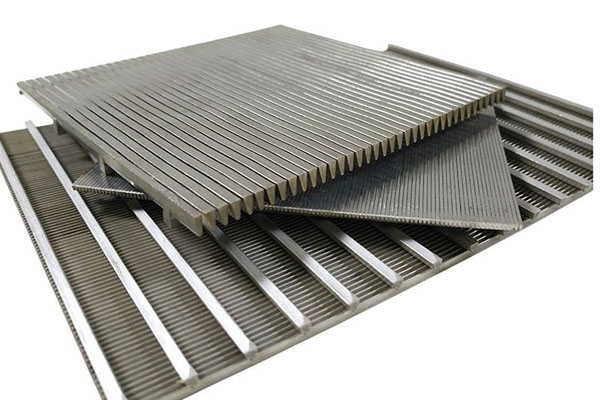
Flow Direction and Edge Customization
Custom wedge wire plates are available in:
Outside-to-Inside (O/I) flow
Inside-to-Outside (I/O) flow
Different edge treatments can also be added for easier installation and improved durability, including:
Flanged edges
Reinforced frames
Bolt holes
Support rings
These customization options allow wedge wire screens to integrate directly into existing machinery.
Technical Specifications
Parameter Specification Range
Slot Size 0.02 mm to 20 mm
Slot Precision ±0.01 mm
Materials 304, 316L, 321, Duplex Stainless Steel
Support Rod Types Round, square, flat, triangular
Maximum Width Up to 80 inches
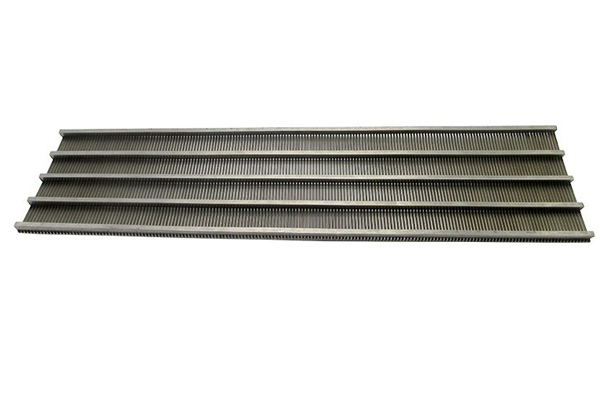
The V-shaped surface wire helps reduce clogging by minimizing particle contact with the screen surface, improving continuous filtration performance.
Common Industry Applications
Wastewater Treatment
Wedge wire screen plates are used in rotary drum screens, intake filtration systems, and sludge treatment equipment. Fine slot openings provide accurate solid-liquid separation while maintaining stable flow.
Mining and Mineral Processing
Mining operations require durable filtration components capable of handling abrasive materials. Wedge wire baskets and sieve bends are widely used for dewatering, classification, and coal washing systems.
Food Processing
In food and beverage production, stainless steel wedge wire screens are used for starch processing, sugar filtration, and liquid separation because of their hygienic surface and corrosion resistance.
Why Choose Custom Wedge Wire Screen Plates?
Custom-designed wedge wire screens provide several operational advantages:
High open area for improved flow
Strong welded structure
Accurate filtration performance
Reduced clogging and maintenance
Long service life in corrosive environments
By selecting the correct slot size, material grade, and screen structure, industrial users can improve filtration efficiency while reducing downtime and maintenance costs.
FAQ
What slot size is best for wedge wire screen plates?
The correct slot size depends on the filtration requirement and particle size. Fine filtration applications often use 0.2–0.5 mm slots, while coarse screening may require larger openings.
Which material is commonly used?
304 and 316L stainless steel are the most commonly used materials because of their corrosion resistance and durability.
Are custom sizes available?
Yes. Wedge wire screen plates can be customized in different shapes, widths, slot sizes, and support structures according to equipment requirements.
What industries use wedge wire screen plates?
These screens are widely used in wastewater treatment, mining, food processing, chemical processing, and industrial filtration systems.
Why are V-shaped wires important?
The V-shaped profile creates continuous slots that reduce clogging and improve flow efficiency during filtration.

 Engineering Principles Behind Vee Wire Scallops for Catalyst Support Systems
 Tower Internal Wedge Wire Pipe Maintenance and Reliability
 Catalyst Bed Support Grid Design for High Efficiency Reactor Flow
 Choosing the Right Vee Wire Scallops for High-Performance Radial Flow Internals
