Filter Nozzle vs Strainer: What’s the Difference in Water Treatment?
In modern water treatment and industrial filtration systems, both filter nozzles and strainers are essential, but they serve fundamentally different purposes. Understanding these differences helps engineers and operators select the right component for system efficiency, reliability, and long-term performance.
This article provides a clear comparison of filter nozzles and strainers, including their functions, filtration accuracy, pressure behavior, and practical applications.
What Is a Filter Nozzle?
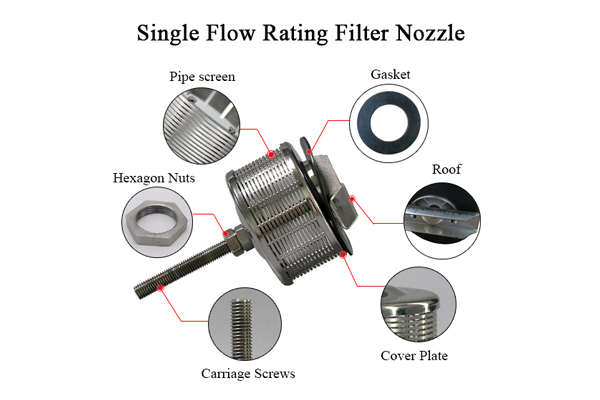
A filter nozzle, also known as a strainer nozzle, is a precision component installed inside filtration vessels, typically at the bottom of tanks. Its main function is to retain filter media, such as sand, gravel, or ion exchange resin, while allowing filtered water to pass through.
Key Features
·Acts as an underdrain system component
·Retains fine filtration media inside the vessel
·Ensures uniform water collection and distribution
·Supports efficient backwashing without media loss
·Uses fine slots, typically ranging from tens to hundreds of microns
·Filter nozzles are critical for maintaining filtration performance and protecting the integrity of the filter bed.
What Is a Strainer?
A strainer is a filtration device installed in pipelines to remove unwanted debris before it reaches sensitive equipment. It is commonly placed at pump inlets or upstream of valves and spray systems.
Key Features
·Serves as a first line of defense
·Removes coarse particles such as rust, scale, and debris
·Designed for high flow rates with minimal pressure drop
·Easy to clean, maintain, or replace
·Strainers are widely used to prevent damage and extend the lifespan of equipment.
We are a professional stainless steel filter nozzle and strainer manufacturer in China. Contact YUBO wedge wire experts!
Key Differences Between Filter Nozzles and Strainers
1. Function
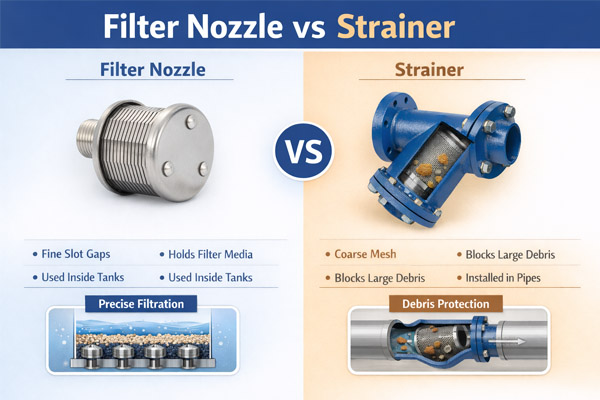
Filter Nozzles: Retain filtration media and collect treated water within vessels
Strainers: Remove large particles to protect downstream equipment
2. Filtration Precision
Filter Nozzles: Fine slot openings (typically tens to hundreds of microns)
Strainers: Coarse filtration (>100–150 microns)
3. Pressure and Flow
Filter Nozzles: Designed to withstand high pressure, especially during backwashing
Strainers: Optimized for high flow rates with low resistance
4. Installation Location
Filter Nozzles: Installed inside filtration vessels
Strainers: Installed in pipelines
5. Applications
Filter Nozzles:
·Multimedia filters
·Water softeners
·Ion exchange systems
Strainers:
·Pump protection
·Valve and nozzle protection
·General pipeline filtration
When Should You Use Each?
Use filter nozzles when you need to retain filter media and ensure even water distribution inside a vessel.
Use strainers when you need to remove coarse particles and protect equipment in piping systems.
In many systems, both components are used together to achieve optimal performance.
Why This Difference Matters
Choosing the wrong component can result in media loss, equipment damage, or inefficient filtration. A well-designed system uses filter nozzles for precision filtration inside vessels and strainers for upstream protection.
Understanding their roles helps improve system efficiency, reduce maintenance costs, and ensure long-term operational stability.
FAQ: Filter Nozzle vs Strainer
Q1: Can a strainer be used instead of a filter nozzle in a tank?
No. Strainers cannot retain fine filtration media or support proper backwashing.
Q2: How long do filter nozzles typically last?
With proper material selection and operation, they offer long service life and require minimal replacement.
Q3: What factors influence the selection of slot or mesh size?
Media size, flow requirements, and system design all determine the appropriate specification.
Q4: Is it common to use both in one system?
Yes. Strainers protect upstream components, while filter nozzles ensure effective filtration within vessels.

 What Is a Coal Centrifuge Basket and How Does It Work?
 Engineering Principles Behind Vee Wire Scallops for Catalyst Support Systems
 Tower Internal Wedge Wire Pipe Maintenance and Reliability
 Catalyst Bed Support Grid Design for High Efficiency Reactor Flow
