
Catalyst bed support grids are critical reactor internals used in fixed-bed reactors across the refining, petrochemical, chemical processing, and environmental industries. Their primary function is to support catalyst loads while ensuring uniform flow distribution throughout the reactor bed.
Although often hidden beneath layers of catalyst and inert support media, the efficiency of a catalyst bed support grid can significantly impact reactor performance. Poor support grid design may lead to excessive pressure drop, flow maldistribution, catalyst loss, hot spots, and reduced process efficiency. Understanding the factors that affect support grid performance is essential for maximizing reactor reliability and productivity.
A catalyst bed support grid is a structural support system installed at the bottom of a catalyst bed. It carries the weight of the catalyst and grading media while allowing process fluids to flow evenly through the reactor.
Modern support grids often utilize stainless steel wedge wire technology because it provides high open area, excellent mechanical strength, and superior resistance to plugging compared to conventional perforated plates.
The efficiency of a support grid directly influences reactor operation.
When flow is distributed evenly across the catalyst bed, process fluids contact more catalyst surface area, improving reaction efficiency and product quality. Conversely, poor flow distribution can create channeling, dead zones, and temperature variations that reduce catalyst utilization.
In severe cases, uneven flow can generate localized hot spots that accelerate catalyst deactivation and shorten reactor run length.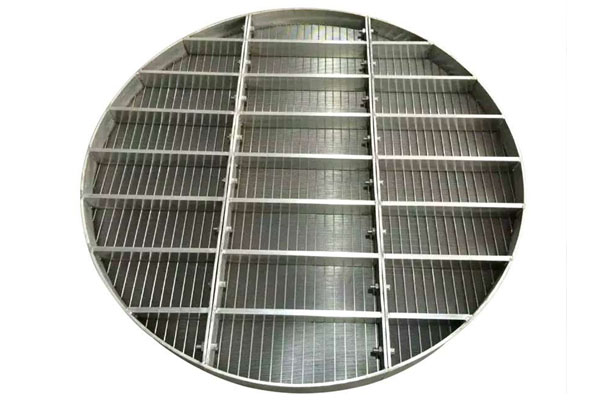
Open area is one of the most important performance indicators for a catalyst bed support grid.
Higher open area allows process fluids to pass through with less resistance, reducing pressure drop and improving flow uniformity. Continuous-slot wedge wire designs generally provide greater open area than perforated plates while maintaining excellent catalyst retention.
Slot size must also be carefully selected. Openings that are too large may allow catalyst particles to migrate, while excessively small slots can restrict flow and increase pressure losses.
Support grids must withstand significant mechanical loads throughout their service life.
In many industrial reactors, catalyst beds can weigh several tons. The grid must resist:
Catalyst loading stress
Thermal expansion and contraction
Process vibration
Pressure fluctuations
Any deformation can disrupt flow patterns and create bypass channels that reduce reactor efficiency.
The layer of inert support media placed above the grid plays an important role in flow distribution.
Properly sized inert balls help:
Distribute fluid evenly
Protect the support grid
Prevent catalyst migration
Reduce localized velocity peaks
Incorrect grading material selection can contribute to plugging, channeling, and uneven catalyst utilization.
The design of support beams affects the available flow area beneath the catalyst bed.
Excessive structural components may obstruct flow and create dead zones within the reactor. Efficient designs balance mechanical strength with hydraulic performance to maximize available cross-sectional flow area.
Over time, process contaminants, coke, polymers, or fine particles may accumulate on reactor internals.
Wedge wire support grids are often preferred because their continuous-slot design provides a self-cleaning effect that minimizes buildup and reduces the risk of plugging.
Lower fouling rates help maintain stable pressure drop and improve long-term reactor performance.
Uniform flow distribution is critical to achieving efficient catalyst utilization.
Ideally, process fluids should pass evenly through the entire catalyst bed. When flow distribution becomes uneven, several operational issues can occur:
Channeling through low-resistance paths
Dead zones with minimal fluid contact
Reduced catalyst utilization
Lower conversion efficiency
Temperature gradients within the reactor
A properly designed catalyst bed support grid helps ensure consistent flow patterns and stable reactor operation.
Pressure drop is one of the most important indicators of reactor performance.
A support grid with insufficient open area or poor hydraulic design can create unnecessary flow resistance. As pressure drop increases, equipment must work harder to maintain throughput, resulting in higher operating costs.
Common consequences of excessive pressure drop include:
Increased energy consumption
Reduced process capacity
Lower reactor efficiency
More frequent maintenance requirements
High-open-area wedge wire support grids are often selected to minimize pressure losses while maintaining catalyst retention.
Material selection depends on operating temperature, pressure, and chemical exposure.
Common materials include:
| Material | Typical Application |
|---|---|
| SS304 | General process service |
| SS316L | Corrosive environments |
| Duplex Stainless Steel | High-strength applications |
| Inconel | High-temperature reactors |
Among these options, 316L stainless steel remains one of the most widely used materials because of its excellent corrosion resistance and durability.
| Feature | Wedge Wire Grid | Perforated Plate |
|---|---|---|
| Open Area | High | Moderate |
| Pressure Drop | Lower | Higher |
| Flow Distribution | Better | Moderate |
| Fouling Resistance | Excellent | Moderate |
| Catalyst Retention | High | Moderate |
Because of these advantages, wedge wire support grids are commonly selected for modern fixed-bed reactor designs.
An efficient support grid can generate significant long-term savings.
Benefits include:
Lower pressure drop and energy consumption
Improved catalyst utilization
Longer catalyst life
Reduced maintenance frequency
Extended reactor run length
By improving hydraulic performance and reducing operational disruptions, a properly designed support grid contributes directly to overall plant profitability.
When selecting a support grid, engineers should evaluate:
✓ Catalyst particle size
✓ Reactor diameter
✓ Operating temperature
✓ Operating pressure
✓ Corrosion conditions
✓ Allowable pressure drop
✓ Catalyst loading weight
✓ Required service life
A balanced design should provide both structural reliability and optimal hydraulic performance.
It supports catalyst and grading media while ensuring uniform flow distribution throughout the reactor.
Higher open area reduces pressure drop and improves flow distribution, resulting in better reactor efficiency.
316L stainless steel is widely used because of its strength, corrosion resistance, and long service life.
Fouling increases pressure drop, restricts flow, and reduces catalyst utilization, leading to lower reactor efficiency.
In many applications, wedge wire grids provide higher open area, lower pressure drop, and better resistance to plugging.
Catalyst bed support grids play a crucial role in reactor performance by supporting catalyst loads and promoting uniform flow distribution. Factors such as open area, slot size, mechanical integrity, support media design, fouling resistance, and material selection all influence efficiency and reliability.
For many modern reactor applications, stainless steel wedge wire support grids offer an ideal combination of high open area, low pressure drop, excellent durability, and long-term operational performance, helping facilities maximize catalyst utilization while reducing operating costs.
 What Is a Coal Centrifuge Basket and How Does It Work?
 Engineering Principles Behind Vee Wire Scallops for Catalyst Support Systems
 Tower Internal Wedge Wire Pipe Maintenance and Reliability
 Catalyst Bed Support Grid Design for High Efficiency Reactor Flow
