Filter Nozzle Slot Size Guide: How to Select the Right Opening
Selecting the correct filter nozzle slot size is one of the most critical decisions in filtration system design. A properly sized slot prevents media loss while maintaining efficient flow distribution, directly impacting system performance, longevity, and maintenance costs.
Why Slot Size Matters
Filter nozzles act as a barrier between the filter media and the outlet system. If the slot size is too large, media such as sand or activated carbon can escape. If it is too small, it can restrict flow, increase pressure loss, and reduce system efficiency.
A balanced design ensures:
Effective media retention
Uniform flow distribution
Minimal pressure drop
Long service life
Core Rule for Slot Size Selection
A widely accepted industry guideline is:
The slot width should be 50% to 70% of the smallest filter media size.
For granular media systems, a simplified rule is:
Slot size ≈ ½ of the minimum media particle diameter
Example
If the smallest media particle size is 0.5 mm, the recommended slot size would be:
0.25 mm to 0.35 mm
Common practical choice: 0.3 mm
This range provides a good balance between retention and flow.
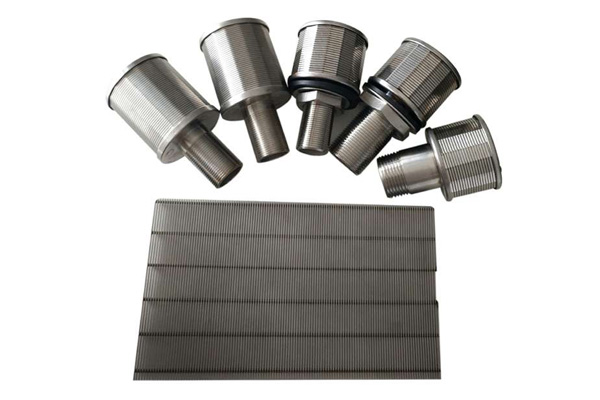
Particle Retention Principle
To ensure effective retention:
The filter media particle size should be at least twice the nozzle slot width.
This ratio minimizes the risk of media passing through the slots, especially under fluctuating flow or pressure conditions.
Key Factors to Consider
When choosing a suitable filter nozzle, you need to consider the following factors.
1. Media Particle Size
Always base your selection on the effective size of the smallest particles, not the average size. Undersized particles are the most likely to escape.
Common media types include:
Silica sand
Activated carbon
Anthracite
Resin beads
2. Flow Rate and Pressure
The number and size of nozzles must support the system’s hydraulic requirements.
Consider:
Total vessel flow rate
Operating pressure
Backwash conditions
Plastic or manifold nozzles may deform under high pressure if not properly selected, while stainless steel options offer higher strength and durability.
3. Application Type
Different environments require different retention strategies:
Water wells (non-corrosive conditions):
A design that allows ~60% passage and retains ~40% of fine particles is often acceptable. Corrosive or critical systems:
A more conservative approach is recommended, using smaller slots to retain at least 50% of fine particles, reducing the risk of sand pumping and system damage.
4. Material Selection
Material choice affects both performance and lifespan:
Stainless steel: High strength, corrosion resistance, suitable for demanding environments
Polypropylene (PP): Cost-effective, good chemical resistance, suitable for lower pressure systems.
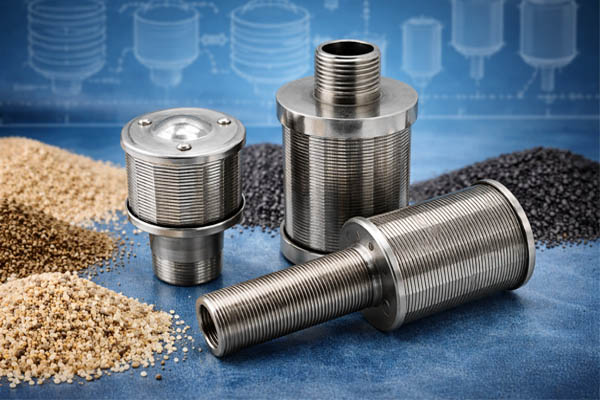
stainless steel Wedge Wire Screen filter Nozzles manufacturer
Step-by-Step Selection Process
Step 1: Analyze Media
Determine the effective size (ES) of your filter media, focusing on the smallest particles.
Step 2: Calculate Slot Size
Select a slot width that is:
50%–70% of the minimum media particle diameter
Step 3: Verify Retention
Ensure:
Media particle size ≥ 2 × slot width
Step 4: Check Pressure Limits
Confirm that the selected nozzle material and structure can withstand:
Operating pressure
Backwash pressure
Mechanical stress
Step 5: Confirm Flow Capacity
Calculate the total open area and ensure the number of filter nozzles supports:
Required flow rate
Even distribution across the vessel
Common Mistakes to Avoid
Using average media size instead of minimum size
Oversizing slots to reduce cost, leading to media loss
Ignoring pressure conditions, especially in plastic systems
Underestimating backwash requirements
Frequently Asked Questions (FAQ)
What happens if the slot size is too large?
Media leakage occurs, leading to contamination, system inefficiency, and potential downstream damage.
What if the slot size is too small?
Flow restriction increases, causing higher pressure drop and reduced filtration efficiency.
Is 0.3 mm a standard slot size?
Yes, it is commonly used for sand media around 0.5 mm, but the correct size always depends on your specific media and system conditions.
Should I always follow the 50–70% rule?
It is a reliable guideline, but adjustments may be needed for unique applications, especially in corrosive or high-pressure environments.

 What Is a Coal Centrifuge Basket and How Does It Work?
 Engineering Principles Behind Vee Wire Scallops for Catalyst Support Systems
 Tower Internal Wedge Wire Pipe Maintenance and Reliability
 Catalyst Bed Support Grid Design for High Efficiency Reactor Flow
