Wedge Wire Sieve Bend Screen vs Flat Panel
Wedge wire screens are widely used in industrial filtration and separation systems because of their high strength, precise slot openings, and non-clogging performance. Among the most common types are wedge wire sieve bend screens (DSM screens) and flat wedge wire panels.
Although both are manufactured from V-shaped profile wires welded to support rods, their working principles, flow characteristics, and application scenarios are significantly different. Selecting the right screen type is essential for improving filtration efficiency, reducing maintenance costs, and maximizing equipment performance.
What Is a Wedge Wire Sieve Bend Screen?
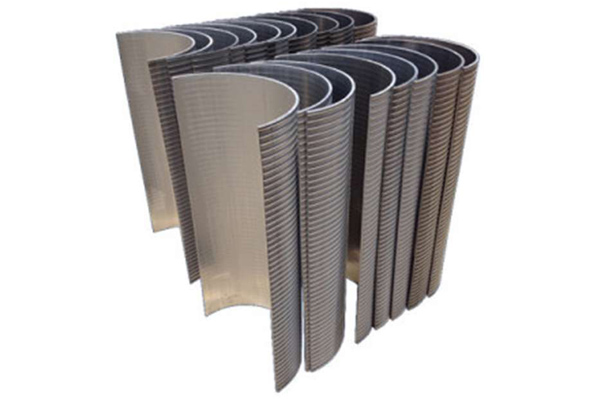
A wedge wire sieve bend screen, also known as a DSM screen, features a curved concave surface designed for gravity-fed liquid-solid separation. The slurry flows tangentially across the curved screen surface, allowing water and fine particles to pass through the slot openings while larger solids slide downward.
Because of its curved design, the sieve bend creates a natural cross-flow effect that improves dewatering efficiency and reduces clogging.
Key Features
Curved arc-shaped structure
Excellent self-cleaning capability
High flow handling capacity
Low maintenance requirements
Ideal for continuous wet processing
Common Applications
Municipal wastewater treatment
Coal and mineral processing
Starch and sugar production
Pulp and paper filtration
Food processing dewatering systems
What Is a Flat Wedge Wire Panel?
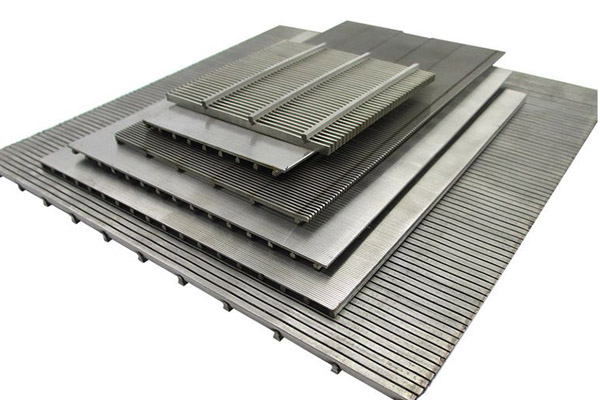
Flat wedge wire panels are rectangular screening surfaces used in static or vibrating screening systems. Unlike sieve bends, flat panels rely mainly on direct gravity flow, pressure, or mechanical vibration to separate materials.
These panels are highly versatile and can be customized into different shapes and sizes for industrial equipment, tanks, vibrating decks, and support grids.
Key Features
Flat and compact structure
Easy customization and installation
Compatible with vibrating equipment
Strong structural support capability
Suitable for dry or mixed material screening
Common Applications
Vibrating screening decks
Aggregate and mining separation
Palm oil recovery systems
Industrial water intake screens
Reactor support grids and vessel internals
Working Principle Comparison
The main difference between sieve bend screens and flat panels lies in how material flows across the surface.
Sieve Bend Screen Working Principle
In a sieve bend system, slurry enters from the top and travels rapidly across the curved screen surface. The tangential flow combined with gravity creates a cross-flow filtration effect. Water passes through the continuous slots immediately, while larger particles remain on the surface and slide downward.
This design allows sieve bends to process high liquid volumes with excellent dewatering efficiency.
Flat Panel Working Principle
Flat wedge wire panels operate using direct downward flow or vibration-assisted separation. Materials move vertically or horizontally across the flat surface while particles smaller than the slot opening pass through the screen.
Compared with sieve bends, flat panels have less self-cleaning capability and may require periodic cleaning during long-term operation.
Sieve Bend Screen vs Flat Panel: Key Differences
| Feature |
Sieve Bend Screen |
Flat Wedge Wire Panel |
| Surface Shape |
Curved concave arc |
Flat rectangular surface |
| Flow Capacity |
Very high |
Moderate |
| Separation Method |
Cross-flow dewatering |
Gravity or vibration screening |
| Anti-Clogging Ability |
Excellent |
Good |
| Maintenance |
Low |
Medium |
| Best For |
Wet slurry separation |
Dry sizing and structural support |
| Typical Installation |
Static gravity-fed systems |
Vibrating decks or tank systems |
Materials and Slot Openings
Both sieve bends and flat wedge wire panels are commonly manufactured from corrosion-resistant stainless steel materials, including:
SS304
SS316L
Duplex stainless steel
Typical slot openings range from:
0.1 mm
0.25 mm
0.5 mm
1.0 mm
Sieve bend screens usually use finer slot openings for efficient dewatering, while flat panels may use wider slots for dry material sizing applications.
How to Choose the Right Screen
Choosing between a sieve bend screen and a flat wedge wire panel depends mainly on the process conditions and material characteristics.
Choose a Sieve Bend Screen If You Need:
High-capacity liquid-solid separation
Continuous slurry dewatering
Low maintenance operation
Efficient wastewater screening
Choose a Flat Panel If You Need:
Vibrating screening systems
Dry material grading
Compact equipment layouts
Customized structural support grids
In many industrial systems, both screen types may even be used together at different processing stages.
Both wedge wire sieve bend screens and flat wedge wire panels provide excellent strength, durability, and filtration performance. However, their operational designs are completely different.
Sieve bend screens are ideal for high-volume wet processing and dewatering applications, while flat panels are better suited for vibrating screening, dry material sizing, and custom structural installations.
Understanding these differences helps engineers and plant operators select the most efficient wedge wire screening solution for their specific process requirements.
FAQ
1. What is the main advantage of a sieve bend screen?
The biggest advantage of a sieve bend screen is its high dewatering efficiency combined with excellent self-cleaning performance. The curved surface allows continuous operation with minimal clogging.
2. Are flat wedge wire panels suitable for wastewater treatment?
Yes. Flat wedge wire panels are commonly used in certain wastewater applications, especially as support grids, intake screens, or vibrating separation equipment.
3. Which screen type requires less maintenance?
Sieve bend screens generally require less maintenance because the cross-flow design helps prevent particle buildup and blockage on the screen surface.
4. Can wedge wire screens be customized?
Yes. Both sieve bend screens and flat wedge wire panels can be customized in terms of slot opening, material, dimensions, support rod structure, and mounting design to match different industrial applications.

 What Is a Coal Centrifuge Basket and How Does It Work?
 Engineering Principles Behind Vee Wire Scallops for Catalyst Support Systems
 Tower Internal Wedge Wire Pipe Maintenance and Reliability
 Catalyst Bed Support Grid Design for High Efficiency Reactor Flow
